How UK Buyers Can Choose a Commercial Outdoor Furniture Supplier
Quick answer
The right commercial outdoor furniture supplier depends on the way you plan to sell, install or replenish the range. A restaurant group replacing terrace chairs next month needs a different supply model from a garden retailer planning a spring collection, and both need something different from a brand developing its own colours and packaging.
For a UK buyer who needs local stock, short lead times or single-project delivery, a UK-based distributor may be the sensible route. For a buyer planning a repeatable range, a container order or a product programme with custom finishes, direct factory sourcing can offer more control. It also asks more of the buyer: clearer specifications, sample approval, packing decisions and a realistic purchasing calendar.
This guide is for importers, wholesalers, garden retailers, e-commerce brands and hospitality buyers comparing commercial outdoor furniture suppliers. It is not a guide to buying a patio set for one home.
First, choose the right supply route
Many supplier comparisons go wrong before the first quotation arrives. The buyer is comparing three different business models as though they are interchangeable.
| Supply route | Usually a good fit when | Main trade-off |
|---|---|---|
| UK stock supplier | You need fast availability, local delivery or small quantities | Less room for exclusive product, packaging or colour development |
| UK wholesaler or distributor | You want a trade account and a ready-made range without managing imports | The selection and buying terms are set by the distributor |
| Direct overseas manufacturer | You can plan a container-scale order, approve samples and manage a longer purchasing cycle | More preparation is needed before the order is released |
Before contacting commercial outdoor furniture suppliers, decide which problem you are actually solving:
- Are you buying for retail, hospitality, a garden centre, an online range or a project?
- Do you need stock now, or are you planning a collection for a future season?
- Will the furniture be sold under your brand?
- Do you need the same colours, materials and specifications on repeat orders?
- Can the order support container planning and sample development?
Those answers should shape the supplier list. They should also shape the brief you send.
A commercial buyer should start with the channel, not the catalogue
A product that looks good in a showroom can still be a poor commercial choice if it wastes warehouse space, ships badly or takes too long to assemble. A garden retailer may need a clear price ladder; a restaurant or hotel buyer may care more about stackability, cleaning and replacement parts; an online brand will look hard at carton dimensions and damage risk.
This is why a good RFQ does more than ask for a price. It should explain:
- the sales channel;
- the intended user and setting;
- the target launch date;
- the likely order volume;
- the products that need to work together as a range;
- the level of customisation required;
- whether future replenishment matters.
When the brief is clear, commercial outdoor furniture suppliers can recommend a more suitable product mix. When it is vague, the buyer often receives a long catalogue and a price list that does not answer the real question.
What to check before you compare prices
Frame and finish
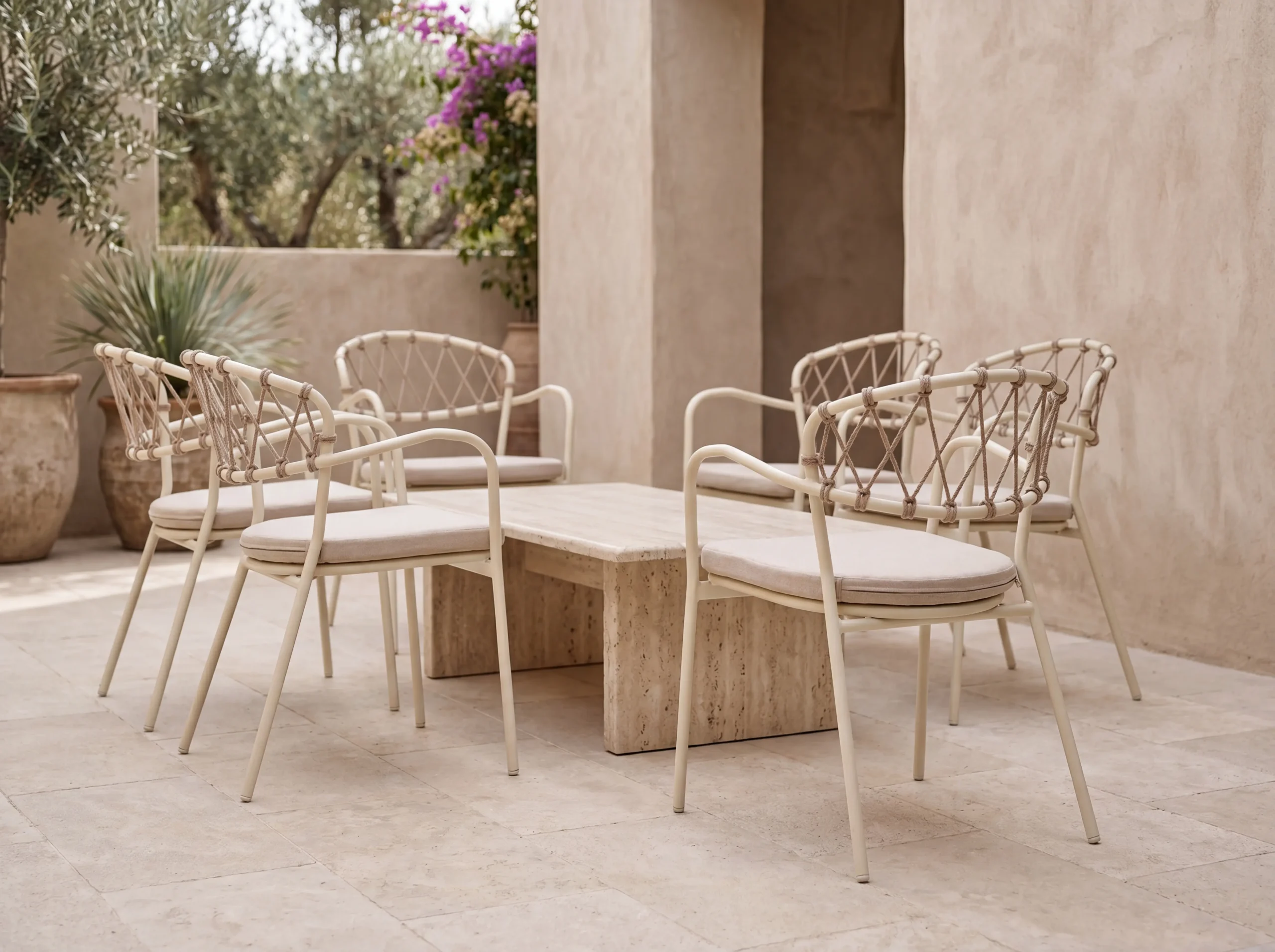
Ask what the frame is made from, how the metal is prepared before coating, and what happens at welds, joints and areas that can hold water. A supplier should be able to explain the construction in plain language rather than simply describe it as weather-resistant.
For a commercial setting, also ask how the chair is handled: can it be stacked, dragged, moved between tables or used on uneven paving? A finish is only one part of the answer. The shape of the frame, protection at contact points and the quality of the fittings all affect how a product wears in service.
Rope, cushions and moving parts
For rope-woven seating, request the material description, colour reference and a sample that reflects the final weave. If cushions are included, confirm the fabric, filling, drainage approach, covers and care instructions. Folding furniture needs a separate conversation about the locking mechanism, pinch points, stability and long-term movement at the hinge.
Packing and replacement parts
Ask for the packing method early. A product can be commercially attractive until the buyer discovers that the carton is oversized, the legs cannot be removed, or the hardware is difficult to replace after delivery.
Useful questions include:
- How is each item protected inside the carton?
- Can chairs be stacked safely for shipment and storage?
- Is a table designed for knock-down packing?
- Are assembly instructions, hardware packs and spare parts available?
- Can the supplier provide an item-specific loading plan after the product and packing are confirmed?
Do not accept a generic container figure copied from another product. Loading quantities depend on the final carton size, packing method and product mix.
MOQ and lead time: make the discussion concrete
At Colors Furniture, the normal starting MOQ is 100 chairs or 50 tables, with a typical production lead time of 45–60 days after the required product details are confirmed. Mixed models, colours and container combinations should be reviewed against the actual materials and production steps rather than promised as a blanket rule.
The earliest conversation should cover four dates:
- when the buyer needs samples;
- when the range must be approved;
- when bulk production needs to start;
- when the goods need to be available in the UK.
Outdoor furniture is seasonal, but production and shipping decisions happen well before the selling season. A good supplier can help map the manufacturing stage. The buyer still needs to work backwards from the launch date.
Why the lowest FOB price can be the expensive option
FOB pricing is useful, but it does not include carton volume, damage risk, assembly time, local handling or replacement-part support. A cheaper chair that cannot stack efficiently may cost more once it reaches the warehouse.
This is particularly relevant for metal and rope outdoor furniture. A buyer should look at the collection as a system:
- Which chairs can share a finish or rope direction?
- Which tables can use related frame colours?
- Which pieces can be packed efficiently without compromising protection?
- Which products are practical to reorder?
- Which parts are likely to be needed after installation or delivery?
A supplier who only discusses price is leaving too much of the decision to chance.
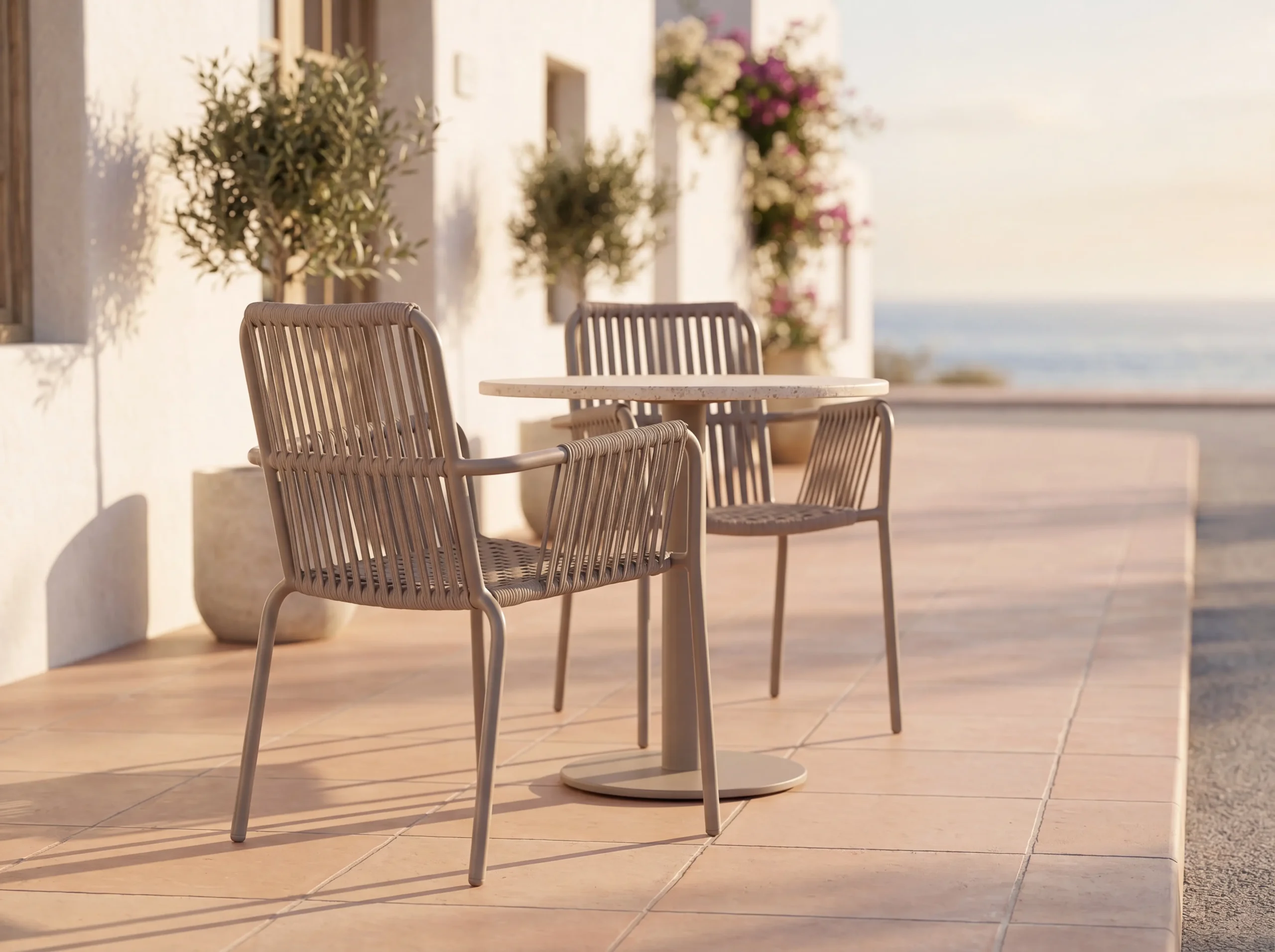
Build a comparison sheet that exposes the differences
When three quotations arrive, put them on one comparison sheet before deciding which supplier looks cheapest. Use the same product specification for each supplier; otherwise, the prices are not comparable.
- Frame material, tube size and finish reference
- Rope, fabric, glass or tabletop specification where applicable
- MOQ by design, colour and product family
- Carton dimensions, gross weight and proposed loading plan
- Sample timing, bulk lead time and inspection stage
- What is included in the quote: hardware, labels, instructions, spare parts and packaging
- Documentation or testing that is already available, and what would need to be arranged
This sheet will not make the decision for you, but it reveals where one low quote is based on a different product, a thinner packing plan or an assumption that has not yet been agreed.
Samples are where repeat-order problems are prevented
The sample stage is where a buyer locks down the details that are difficult to reconstruct later:
- a written product specification;
- an approved physical sample or agreed finish reference;
- packing confirmation before bulk production;
- a clear record of the changes made after sampling;
- inspection criteria that both sides understand.
Keep that record with the purchase order; it is a better reference than a memory of what looked right in a video call.
Documentation is part of the supply decision
Commercial furniture buyers should discuss documentation before goods are on the water, not after. The exact requirements depend on the product, route to market and buyer’s responsibility, but it is sensible to ask what is available for product identification, materials, assembly, use instructions, traceability and relevant testing.
For products placed on the Great Britain market, businesses need to be able to demonstrate that products meet relevant safety requirements and can be traced through the supply chain. The UK government’s product safety guidance for manufacturers and importers is a useful starting point. It does not mean every outdoor furniture item needs the same documentation or testing programme.
If packaging is part of the buyer’s branded supply chain, ask for component weights by material. UK packaging EPR obligations depend on the business model and supply chain, but the current government guidance on packaging data shows why a basic carton weight alone may not be enough.
Do not ask a supplier to claim that every product is “fully UK certified” unless there is a current, product-specific basis for that statement. A better question is: what documents and third-party testing can be provided or arranged for this exact product and intended use?
SCENARIO:
A mid-sized UK garden retailer is planning a new outdoor dining programme for the following spring. Instead of selecting twelve unrelated SKUs, the buying team starts with two stackable chair designs, one compact bistro table and one four-seat dining table. They request samples in two frame colours, decide which pieces need branded cartons, and ask for an item-specific packing proposal before confirming the final mix.
The team then checks whether the chair, table and replacement-part plan can be carried into the following season. That process does not guarantee a successful range, but it reduces the common problem of buying attractive products that cannot be packed, replenished or supported consistently.
A short checklist before you appoint a supplier
Before you confirm a commercial outdoor furniture supplier, make sure you can answer these questions:
- Is this supplier set up for stock delivery, trade distribution or factory-direct production?
- Does the MOQ fit the order and the purchasing calendar?
- Have the frame, finish, rope, fabric and fittings been specified clearly?
- Have you approved a sample that reflects the final product?
- Is the packing plan specific to the products you are buying?
- Do you know which documents and tests your route to market requires?
- Can the same collection be produced again with a controlled specification?
- Does the supplier understand your sales channel rather than only your target price?
Looking for a factory-direct sourcing discussion?
Colors Furniture manufactures metal and rope outdoor furniture in Foshan, China for brands, importers, wholesalers, retailers and hospitality projects. Share the customer channel, product direction, expected quantity and target launch date to establish whether a direct-factory programme is a fit.
For related sourcing guidance, see how to find outdoor furniture suppliers in China, the wholesale outdoor furniture manufacturers guide, the hotel outdoor furniture wholesale guide and the outdoor rope material guide.
Start a UK sourcing conversation
Send your product category, expected quantity, target launch date and customisation requirements to colorsfurniturefactory@gmail.com, or call +86 186 8822 2158. We will review whether a direct-factory programme fits your buying model before recommending a next step.
Before contacting the team, you can also review our company profile, take a look inside production in our factory tour, or see how we handle product development, finishes and packaging through our OEM solution.