Why This Matters
If you’re buying heavy duty folding chairs right now, you’re overpaying for aluminum — and the market knows it.
The global outdoor folding chair market sits at $4.8 billion as of 2025, heading toward $7.9 billion by 2034, but the composition of that growth is changing fast. Aluminum hit $3,650/ton in May 2026, up 47% from early 2025. Steel HRC? $1,022 — up a modest 25%. That divergence is reshaping the entire supply chain. At our factory in Foshan, we’ve watched buyer inquiries shift from “Which color options do you have?” to “Can your steel chairs handle 500 lbs? What’s your coating process?”
The Material Cost Divergence
Two forces are reshaping the heavy duty folding chair market, and they’re pulling in opposite directions.
Force one: raw material cost divergence. This is the big one. Aluminum LME hit $3,650–$3,700 per ton in May 2026 — a 47% year-over-year increase from early 2025 levels around $2,500. Steel HRC, meanwhile, sits at $1,022–$1,076 per short ton, up a relatively modest 25% from its 2025 trough near $800. That gap has fundamentally changed the cost equation for manufacturers.
For a heavy duty folding chair that needs to support 350–500 lbs, the frame material choice used to be straightforward. When aluminum was roughly comparable in price, the weight savings made it an easy sell. Now? A carbon steel heavy duty chair with powder coating comes in at $10–$20 per unit FOB China. An equivalent aluminum chair? $45–$130. The steel option is 55–85% cheaper, depending on finish and tubing gauge.
In our experience, that kind of delta changes buyer behavior fast. We’ve seen a measurable shift in Q2 2026 orders toward carbon steel frames, particularly for event seating and institutional applications where chairs are stored indoors and weight isn’t the primary constraint.
Force two: the commercial quality gap. The second driver is harder to quantify but equally important. The post-COVID boom in outdoor dining and events flooded the market with low-cost folding chairs from new manufacturers. Three years in, those chairs are failing. Bent frames, rusted joints, cracked welds. We’re getting inquiries from buyers who bought cheap aluminum chairs in 2023 and are now replacing their entire inventory.
As we discussed in our guide on commercial outdoor furniture for cafes and restaurants, the total cost of ownership over a 3–5 year period often favors a slightly more expensive chair that lasts. That lesson is playing out in real time right now across the hospitality industry.
The Numbers Speak
Let me lay out the numbers that matter for anyone buying heavy duty folding chairs in volume.
Market size and growth:
– Outdoor folding chair market: $4.8B (2025) → $7.9B (2034), CAGR 5.8%
– Folding deck chairs sub-segment: growing at 13.4% CAGR (2026–2033) — more than double the overall market
– Outdoor camping chairs: 4.4% CAGR (2026–2033), with lightweight materials as the key differentiator
The 13.4% CAGR for folding deck chairs is worth pausing on. That segment overlaps heavily with commercial patio and hospitality applications — exactly where heavy duty folding chairs are specified. It tells us that demand for commercial-grade outdoor folding seating is growing significantly faster than the consumer camping segment.
Material cost comparison (current FOB China, verified Q2 2026):
| Material | FOB Range (per chair) | Key Advantage | Key Trade-off |
| Carbon steel (powder coated) | $10 – $20 | Lowest cost, strongest frame | Heavier (7–14 kg) |
| Extruded aluminum | $45 – $130 | Lightweight (3–7 kg) | Cost premium, lower strength-to-weight |
| Cast aluminum | $65 – $180 | Premium look, corrosion-resistant | Heaviest premium option |
Raw material trajectory (LME data):
– Aluminum: ~$2,500 (Jan 2025) → $3,650–$3,700 (May 2026) = +47%
– Steel HRC: ~$800 (2025 low) → $1,022–$1,076 (May 2026) = +~25%
– Aluminum forecast: Goldman Sachs projects potential drop to $2,350 by Q4 2026
That aluminum correction, if it happens, could shift the equation again. But for orders placed today, the math is clear.
I’ve been tracking these numbers weekly since early 2025, and the 47% aluminum spike is the sharpest single-year increase I’ve seen in the outdoor furniture raw materials market. For comparison, even during the 2021 supply chain crisis, aluminum peaked at around $3,200 before correcting. Current levels are 14% above that peak.
How the Industry Is Responding
This material cost shift is playing out differently depending on who you are in the supply chain.
For large manufacturers — the ones producing 50,000+ units per month — the response has been to dual-source. They’re maintaining aluminum lines for their premium product tiers while expanding carbon steel capacity for the volume mid-range. The big players can absorb the cost volatility because they have negotiating power with both material suppliers and logistics providers.
For smaller to mid-size manufacturers — and this is where we fit — the response is different. We’re leaning into steel because that’s where our expertise and production line efficiency are strongest. A carbon steel folding chair with automotive-grade E-coat primer and a textured powder top coat can match the corrosion resistance of aluminum at a fraction of the cost. The weight trade-off is real — our heavy duty steel chairs run 8–12 kg depending on the model — but for 90% of commercial applications, that’s not a dealbreaker.
For buyers, the implications are straightforward but worth stating: the gap between “cheap” and “quality” has widened. At $10–$20 FOB for a properly built steel chair with certifications, there’s no excuse to buy the unbranded $8 option from a trader who can’t show you a factory. The difference in lifespan is 2–3 years versus 8–10 years.
The E-coat process is one of those details that separates real manufacturers from assemblers. In our production line, every steel frame goes through a 12-stage pretreatment and cathodic epoxy dip before powder coating — the same process used in automotive chassis. It bonds at a molecular level, which means even if the powder coat gets scratched, the steel underneath is still protected. That’s how you get a steel outdoor chair that lasts as long as aluminum in real-world conditions.
As we covered in our breakdown of hidden costs in B2B outdoor furniture sourcing, the material choice alone drives 30–40% of landed cost variance — so getting this decision right upfront matters.
What Buyers Should Do Right Now
If you’re sourcing heavy duty folding chairs for Q3–Q4 2026 delivery, here’s my recommendation based on what we’re seeing on the factory floor.
Lock in steel pricing now. The steel market has been more predictable than aluminum, and current HRC levels around $1,050/short ton are manageable relative to recent history. With aluminum at 47% above early 2025 levels and the potential for a Q4 correction to $2,350, the smart play is to buy steel now and wait on aluminum if your timeline allows.
Ask for coating documentation. Not just “powder coated” — ask for the full spec. If your supplier can’t tell you the pretreatment process, the coating thickness (target 60–80 microns for outdoor), and the salt spray test hours, they’re not building to commercial standards. At our facility, we run 1,000-hour salt spray tests on every frame batch. That’s the difference between a chair that rusts in year two and one that’s still solid in year eight.
Spec the right frame for the application.
– Indoor event use: carbon steel, $10–$20/unit, 8–12 kg, 500+ lb capacity
– Outdoor hospitality (covered): carbon steel with E-coat + outdoor powder, $12–$20/unit
– Outdoor hospitality (uncovered, coastal): aluminum or stainless steel, $45–$130/unit
– Premium/custom: cast aluminum, $65–$180/unit, when aesthetics justify the cost
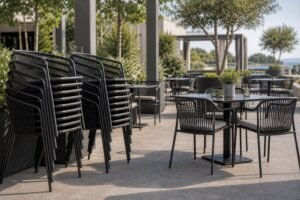
Stacking and storage efficiency matters more than you think. A properly designed heavy duty chair should stack 8–12 high. That’s not just a warehouse convenience — it directly affects your shipping costs. A 40-foot container of stacking chairs carries roughly 40% more units than the same container of non-stacking chairs.
Preparing for 2027
Looking ahead, here’s what I think the heavy duty folding chair market looks like.
First, the aluminum correction will come — Goldman Sachs and AEGIS Hedging are both projecting $2,350/ton by Q4 2026. When that happens, expect to see a wave of hybrid designs hitting the market: steel frames with aluminum components where weight matters most (like the folding mechanism and armrests). We’re already prototyping a few of these.
Second, certification requirements are going to tighten. As more institutional buyers — schools, government, healthcare — enter the outdoor furniture procurement cycle, the demand for documented compliance is rising fast. Right now, ISO 9001 and BSCI are the baseline. Within 18 months, I expect BIFMA outdoor furniture standards or equivalent to be a requirement for any commercial project over a certain size.
Third, customization will become table stakes, not a premium add-on. We’re already seeing RFQs that require specific powder coat colors matched to brand guidelines, laser-cut logos on chair backs, and custom stacking configurations. The manufacturers who survive the next shakeout will be the ones who can handle customization at scale without disrupting their production line efficiency.
The market is shifting from “buy folding chairs” to “specify a seating solution.” That’s a higher bar, but it also means buyers who understand the material dynamics and manufacturing process — not just the catalog price — will come out ahead.
If you’re evaluating potential partners, our guide to wholesale outdoor furniture manufacturers covers the certification checklist we recommend every buyer verify. Manufacturers who don’t invest in certification will find themselves locked out of the fastest-growing segment of the market.
Interested in sourcing heavy duty folding chairs for your next project? At Colors Furniture, we manufacture carbon steel and metal folding chairs with full certification documentation, E-coat protection, and custom color matching.
Contact us for a factory tour or a quote on bulk orders.