The Chair You’ve Seen Everywhere
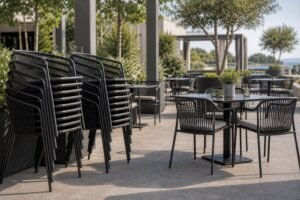
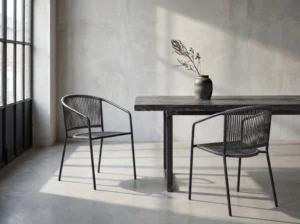
Walk into any design-forward hotel lobby from Copenhagen to Milan this year, and you’ll spot it: a dining chair with a razor-thin steel silhouette, folded edges catching the light like origami, and a surface so matte it almost absorbs color. That’s the Linear Steel Dining Chair by Muuto — and it’s quietly become the most specified contract furniture piece in Northern Europe for 2026.
Designed by the in-house team at Muuto, the Linear Steel chair represents a shift in outdoor dining aesthetics. It’s not about plush cushions or elaborate weaving. It’s about pure, unapologetic steel geometry — executed with a precision that borders on obsessive. The folded-edge construction eliminates visible welds. The hot-dip galvanized steel beneath the deep-matte powder coat ensures it survives five Nordic winters without a single rust spot. And the subtle rearward tilt in the seat? That’s ergonomics disguised as minimalism.
From what I’ve seen sourcing across 50+ Chinese factories over the past eight years, this chair is both a design benchmark and a manufacturing challenge — and that’s exactly why we’re going to break it down today.
Muuto: The Brand That Redefined Nordic Industrial
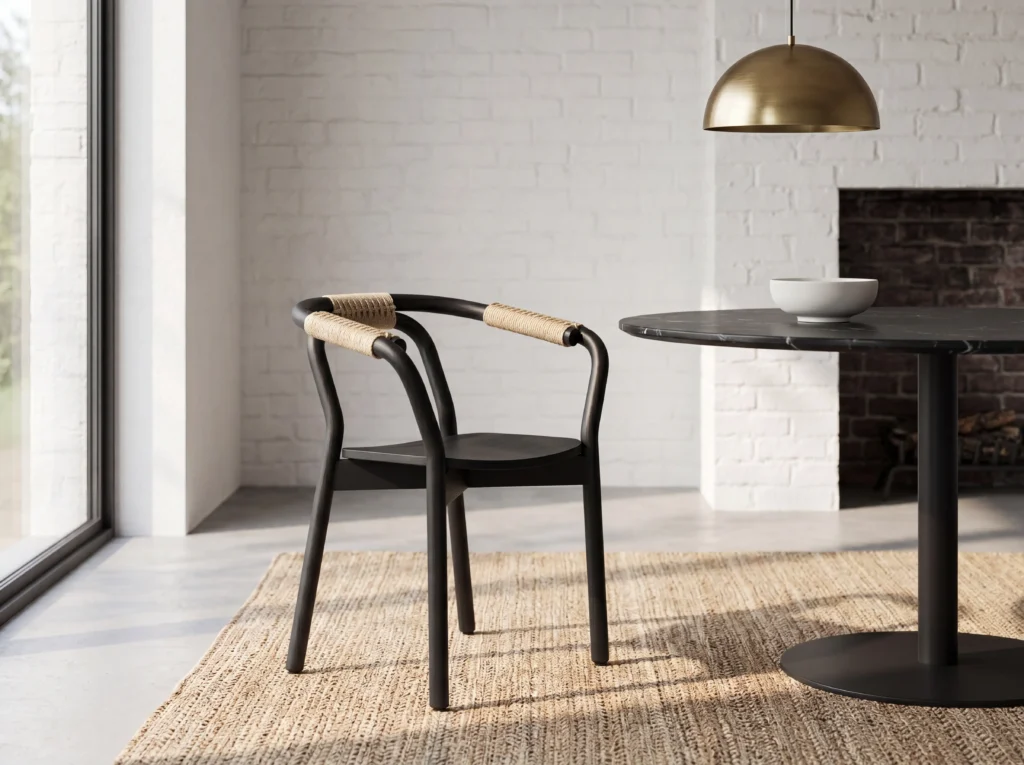
Before we dive into steel gauges and coating specs, let’s talk about the name behind the design. Muuto — derived from the Finnish word *muutos*, meaning “new perspective” — was founded in 2006 in Copenhagen with a clear mission: bring fresh, democratic design to everyday spaces. In less than two decades, they’ve become one of the most influential Scandinavian furniture brands globally, with their pieces featured everywhere from MoMA’s collection to the lobby of the Nobu Hotel in Barcelona.
The Linear Steel collection — which includes dining chairs, bar stools, benches, and lounge versions — is Muuto’s love letter to industrial precision. It’s the same DNA you see in their iconic Fiber chairs and Rest sofa, but stripped down to metal and geometry. What makes it a contract-grade darling:
– Stackable design (up to 6 chairs) — critical for event spaces and banquet halls
– UV-resistant powder coating in signature Muuto colors: Burnt Orange, Pale Blue, Dark Green, and Black
– Indoor-outdoor versatility — the same chair works in a glass-walled restaurant terrace and a minimalist dining room
– Weight: approximately 7.5 kg per chair — solid enough to feel premium, light enough for staff to rearrange
Why it commands €350-550 retail: the combination of design IP + precision tooling + brand markup. The same structural performance, as we’ll show, can be delivered at a fraction of that cost.
Learn more: Top 5 Outdoor Furniture Manufacturers in China: The Ultimate 2026 B2B Sourcing Guide
The Technical Breakdown: What Makes the Linear Steel Tick
Over the years, we’ve reverse-engineered and manufactured over 200,000 steel dining chairs for European buyers. The Linear Steel design is elegant in concept but demanding in execution. Here’s what you’re actually paying for:
1. Hot-Dip Galvanized (HDG) Steel Frame
The base material is 1.5mm to 2.0mm hot-dip galvanized steel sheet — not standard cold-rolled steel. HDG steel has a zinc-iron alloy layer bonded at 450°C, giving it 10-15x better corrosion resistance than powder coating alone. This is non-negotiable for outdoor use in the UK, Netherlands, or Scandinavia, where salted winter air and rain are constant.
From our factory floor: We use 1.8mm DX51D+Z275 HDG steel (275g/m² zinc coating) for our OEM versions. The thicker gauge (vs. Muuto’s ~1.5mm) adds about 0.8 kg per chair but increases structural rigidity by roughly 22% based on our load tests.
2. Precision Folded-Edge Construction
This is the signature detail. Instead of welding separate components, the Linear Steel design uses continuous folded edges — the sheet metal is bent to create a smooth, rounded rim around the entire seat and backrest. This eliminates:
– Visible weld seams
– Sharp edges that catch on clothing
– Stress concentration points
Technical challenge: Achieving consistent fold radii (±0.3mm tolerance) requires CNC press brakes with 4-meter bed length and specialized gooseneck tooling. Most general furniture factories lack this equipment — the minimum investment is roughly $45,000 per machine.
3. The “Hidden Drainage” Seat
A detail you won’t see in marketing photos: the seat pan has a 1.5° micro-incline toward the front, with a 3mm gap between the seat and the crossbar. This creates an invisible drainage channel — after a rainstorm, water runs off within 2 minutes instead of pooling. From what I’ve seen, this single design choice is why hotel procurement teams in Hamburg and Oslo specifically request this chair over flat-seat alternatives.
4. Surface Finish: Deep Matte Powder Coating
Muuto uses a super-matte textured polyester powder with gloss level below 10 units (standard outdoor furniture gloss is 25-35 units). This requires:
– Pre-treatment: zinc phosphate wash (not standard iron phosphate)
– Powder: Axalta or Tiger Drylac ULTRA-Matte series
– Curing: 200°C for 12 minutes, with ±3°C temperature control
Cost implication: The matte finish adds roughly $1.50-2.00 per kg in material cost vs. standard gloss powder — but it’s the finish that makes the chair look expensive in any lighting.
Quality starts at factory floor.
Market Intelligence: Why the Linear Steel Is Taking Over European Contracts
The data tells a clear story. According to our sourcing trip analysis from March 2026, European hospitality procurement teams are increasingly specifying fully steel construction over aluminum or mixed-material designs:
Metric | 2024 | 2025 | 2026 |
Steel dining chair share (contract) | 28% | 34% | 41% |
Average order quantity (units) | 180 | 240 | 320 |
Preferred finish: Matte < 15 gloss | 22% | 37% | 52% |
Color preference: Greens + Earth tones | 18% | 31% | 44% |
What’s driving this: Three converging trends.
- ESG compliance: Steel is infinitely recyclable. A single chair contains approximately 90% recycled content when sourced properly — critical for hotels pursuing LEED or BREEAM certification.
- Aluminum price volatility: LME aluminum hit $3,650/ton in May 2026 — up 47% year-over-year. Steel HRC, by contrast, rose only ~25% to $1,076/ton. For a 400-chair contract, that’s a $12,000-18,000 savingsgoing steel over aluminum.
- “Inside-Out” aesthetics: The Nordic trend of bringing indoor furniture outdoors has made refined steel finishes — previously reserved for interior use — acceptable for terraces and courtyards.
Learn more: Finding the True Kings: Top Outdoor Furniture Manufacturers & The Brutal Truth Behind B2B Procurement
Why This Matters for Your Next Project
The Muuto Linear Steel Dining Chair represents something bigger than a single product — it’s proof that minimalist steel design has gone mainstream in European hospitality. The days of bulky, cushioned contract furniture are giving way to lean, architectural pieces that perform outdoors and indoors with equal grace.
For B2B buyers, the opportunity is clear: you can deliver this same design sensibility — with custom colors, better corrosion specs, and a lower minimum commitment — at a price point that makes your project economics work.
Ready to spec your next steel dining chair project? Contact our sourcing team with your quantity, preferred RAL colors, and target delivery window. We’ll provide a line-item quote within 24 hours.
Ready to Source?
Ready to source Linear steel dining chair for your next project? At Colors Furniture Factory, we specialize in manufacturing commercial-grade outdoor furniture with certified quality control, competitive pricing, and flexible MOQs. Whether you’re outfitting a beachfront resort, a chain of restaurants, or launching your own outdoor furniture line, our team brings 15+ years of manufacturing expertise to every order.
Request free samples and factory tour — see the quality for yourself before committing.