Why This Matters
That’s why we’ve put together this guide—to give you a clear, actionable framework for evaluating and selecting wholesale outdoor furniture manufacturers in 2026.
Key Factors to Consider
Production Capacity & Scale
Monthly container output is the first number you need. A mid-tier manufacturer should quote 30-50 containers per month during peak season (March-September). Top-tier factories in Foshan’s Lecong district operate 80,000-120,000 sqm facilities with 800+ workers across 8-12 production lines.
Here’s what adequate capacity looks like by order size:
• Small wholesale (1-5 containers/month): factory should have 3+ dedicated production lines
• Mid-volume (5-20 containers/month): 8+ lines, 500+ workers, 50,000+ sqm facility
• Large volume (20-50 containers/month): 15+ lines, 1,000+ workers, automated welding/coating
Red flags to watch for: factories that can’t name their monthly capacity in containers, those who subcontract finishing work to third parties (quality control loss), and those whose peak season delivery record shows >30% late shipments. Always verify capacity claims with client references and consider visiting during peak production months.
Material Quality & Sourcing
Manufacturers with strategic partnerships at the raw material level get better pricing and priority during supply crunches. Foshan factories sit within 50km of China’s largest steel processing hubs—this proximity translates into 10-15% lower material costs vs. factories in central China.
Material comparison for outdoor furniture:
• Q195/Q235 carbon steel: $0.55-0.75/kg, standard for powder-coated frames, lifespan 5-8 years with proper coating. Wall thickness should be 1.2mm (chairs), 1.5mm (tables), 2.0mm (commercial)
• 304 stainless steel: $2.50-3.50/kg, 3-4x cost of carbon steel, ideal for coastal/humidity zones, no coating needed but requires skilled TIG welding
• 6063-T5 aluminum: $3.00-4.00/kg, rust-proof, 40% lighter than steel, premium positioning, requires specialized welding (MIG or TIG)
• Synthetic wicker (PE/PVC): $4-8/kg for commercial grade with UV stabilizers, vs $2-3 for budget grade. The price difference shows in year 2-3 when budget wicker starts cracking
Always request mill test certificates for the specific batch, not generic supplier certificates. A factory that stocks 3+ grades of steel and 5+ colors of powder coat daily has the supply chain depth to handle your orders without delays. One that ‘orders materials after receiving your PO’ will add 10-15 days to every lead time. our guide on Top 5 Outdoor Furniture Manufacturers in China: The Ultimate 2026 B2B Sourcing Guide
Finishing & Coating
Coating quality is the #1 differentiator in outdoor furniture. A $2 difference in coating cost per unit can mean the difference between a 3-year and a 8-year product lifespan. The full process should be:
Step 1: Alkaline degreasing (60°C, 5 min) to remove oils
Step 2: Phosphating (zinc phosphate for carbon steel, 50°C, 8 min) for rust prevention
Step 3: E-coat (cathodic epoxy, 180°C curing) — 20-30 micron anti-corrosion primer
Step 4: Powder coating (polyester TGIC, 200°C curing) — 60-80 micron color layer
Step 5: Quality check (salt spray test, adhesion test, thickness measurement)
Real-world coating cost comparison per chair frame:
• Basic: single-layer powder coat + manual spray → $1.50-2.50/unit, 2-3 year lifespan
• Standard: e-coat + powder coat → $3.50-5.00/unit, 5-7 year lifespan
• Premium: e-coat + powder coat + UV clear coat → $5.50-8.00/unit, 8-12 year lifespan
Demand salt spray test reports. A factory that achieves 500+ hours of salt spray resistance has world-class coating. Minimum acceptable for commercial outdoor use is 72-100 hours. Also ask about UV resistance testing—QUV test data showing 1,000+ hours of exposure without significant color change indicates quality powder from brands like Interpon or AkzoNobel.
For a deeper look at what separates top-tier manufacturers, check out our guide on Finding the True Kings: Top Outdoor Furniture Manufacturers & The Brutal Truth Behind B2B Procurement
MOQ & Pricing
MOQ structures vary by factory type. Large factories (500+ workers) typically require 200-500 units per design with 2-3 design minimums. Medium factories (100-300 workers) offer more flexibility: 100-300 units per design, sometimes accepting 50-unit trial orders.
Typical FOB pricing ranges by material (per piece, 500-unit order):
• Carbon steel dining chair: $18-35 FOB Shenzhen
• Aluminum dining chair: $35-65 FOB Shenzhen
• Steel/aluminum lounge chair: $45-120 FOB
• Commercial-grade stacking chair: $25-50 FOB
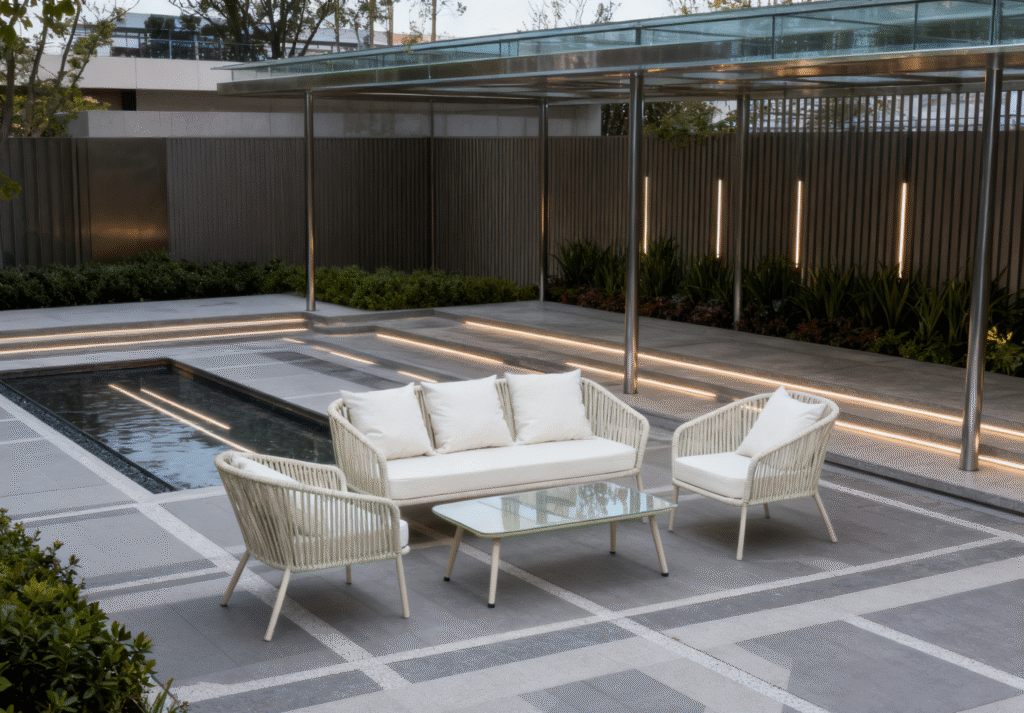
• Wicker/steel sofa set (3-seat): $150-350 FOB
What FOB does NOT include: inland trucking ($150-400/container), customs clearance ($80-200), port handling fees ($200-500), ocean freight ($1,500-4,000/40’HC to US West Coast), insurance (0.3-0.5% of cargo value), and destination port fees. A $30/chair FOB price can become $45-50/chair landed cost. Factor this into your margin calculations.
Negotiation tip: offer an annual volume commitment in exchange for tiered pricing. E.g., ‘I’ll order 3,000 units across 3 designs this year if you give me $22 instead of $26.’ Most factories prefer predictable volume over spot orders and will discount 10-18% for annual commitments.
R&D & Customization Capability
In-house R&D separates OEM factories from true ODM partners. A factory with 10+ product engineers can go from your napkin sketch to production-ready samples in 2-3 weeks. The best ones have:
• 3D modeling (SolidWorks/Rhino) with rendering for client approval before mold creation
• In-house mold-making workshop (3-5 mold makers, CNC machines) — mold development $3,000-10,000
• Rapid prototyping (3D-printed samples for form check before steel molds)
• Structural testing (BIFMA standards: 100,000+ cycle durability testing for seating)
Questions to ask:
• How many new SKUs did you launch last year? (50+ indicates strong R&D capability)
• Can you develop from my photos/sketches, or only from technical drawings?
• What’s your average mold modification cost? ($200-500 per revision is standard)
• Can you offer exclusive designs that I own the tooling for?
The factory’s willingness to invest in R&D for your project tells you whether they see you as a long-term partner or just another order. Factories that charge high mold fees upfront but offer to refund them after a certain order volume are signaling partnership intent.
Logistics & Shipping
Your factory’s location relative to export ports directly affects cost and reliability. Foshan/Dongguan factories ship through Shenzhen’s Yantian or Shekou ports—30-40 min trucking. Zhongshan/Zhuhai factories use Zhongshan port or Nansha (Guangzhou). Zhejiang factories ship via Ningbo port. Each 100km of inland transport adds $100-200 per container.
Shipping cost benchmarks (July 2026 estimate, 40’HC container):
• China (Shenzhen) → US West Coast: $2,500-4,000 | 14-18 days
• China (Shenzhen) → US East Coast: $4,000-6,000 | 22-28 days
• China (Ningbo) → Europe (Rotterdam): $2,000-3,500 | 25-30 days
• China (Ningbo) → Australia (Sydney): $1,500-2,500 | 15-20 days
Container capacity: a 40’HC container fits approximately 250-400 dining chairs (assembled), 600-1,200 chairs (flat-packed), or 80-150 sofa sets. Know your product’s loading efficiency before negotiating freight costs—flat-pack designs can reduce per-unit shipping cost by 40-60%.
Document red-flags: factories that ask you to ‘arrange your own shipping’ without offering recommended freight forwarders may be inexperienced with export. Those who can produce complete export documentation (commercial invoice, packing list, bill of lading, CO, form A/E, fumigation certificate) within 24 hours of container loading have mature export processes.
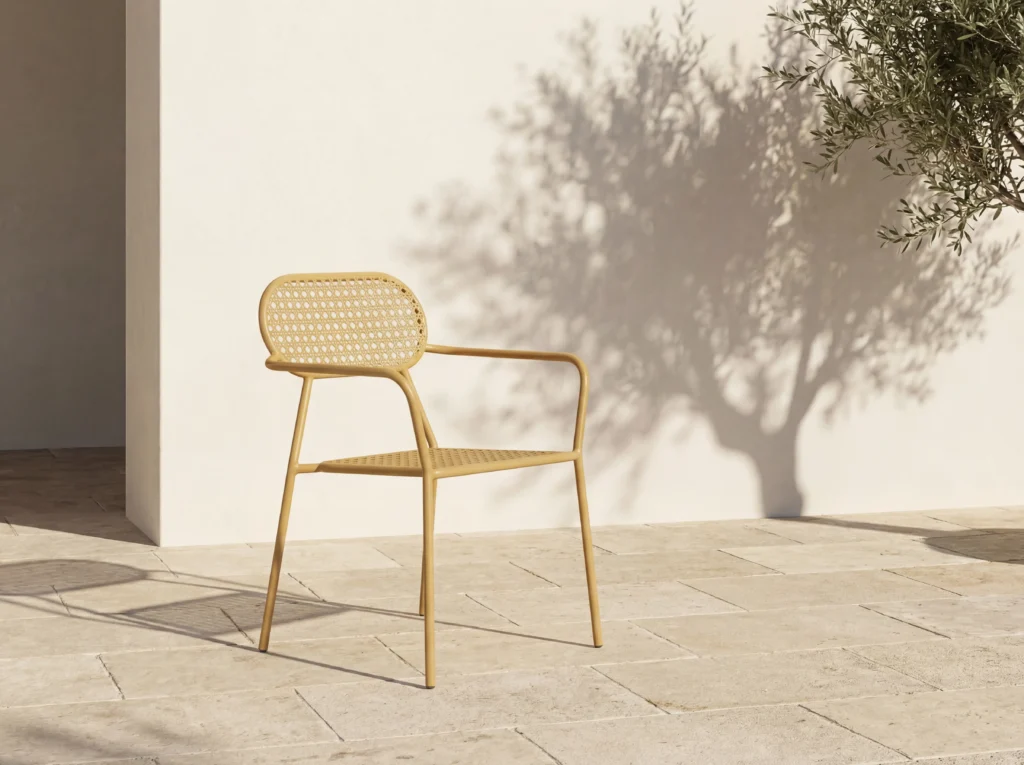
Showroom displays reveal a manufacturer’s design capabilities.
China vs. Other Manufacturing Hubs
China remains the dominant manufacturing hub for outdoor furniture, particularly the Pearl River Delta (Foshan, Dongguan, Zhongshan, Shenzhen). The concentration of over 3,000 furniture factories within a 50km radius creates an unmatched ecosystem: steel mills, coating suppliers, packaging manufacturers, and logistics providers all within short distance. This clustering effect reduces lead times by 10-15 days compared to emerging manufacturing hubs.
Regional specialization within China:
• Foshan (Lecong, Shunde): China’s furniture capital. 200,000+ workers, 5,000+ furniture enterprises. Best for metal and mixed-material outdoor furniture. Home to established export brands.
• Dongguan (Houjie): Higher-end furniture, stronger design capabilities. More expensive but better QC.
• Zhongshan (Guzhen): Lighting-focused but also strong outdoor metal furniture. Smaller factories, more flexible MOQs (50-100 units possible).
• Zhejiang (Anji, Hangzhou, Ningbo): Known for outdoor metal furniture. Excellent port access through Ningbo-Zhoushan port (world’s busiest by cargo tonnage). Some factories specialize exclusively in aluminum outdoor furniture.
Vietnam (Binh Duong, Ho Chi Minh City area): Labor costs are 20-30% below Southern China. Strong for woven outdoor furniture (rattan, synthetic wicker, seagrass). Weakness: raw material ecosystem is underdeveloped—many components still sourced from China. Typical lead times 45-70 days vs China’s 30-50. Best suited for woven lines; for metal outdoor furniture, China retains a clear 15-25% cost advantage.
Turkey (Istanbul, Bursa): Emerging as a competitive hub for European buyers. 7-14 day shipping vs 30-40 days from China. Strong in wrought iron and forged aluminum. Pricing 10-20% above China. Best for European buyers prioritizing speed and communication over absolute lowest cost. The Turkish government’s export incentives (up to 30% freight subsidies for certain categories) can narrow the price gap.
Indonesia (Jepara): World-class teak furniture. 30-50% cheaper than teak from China. But limited to wooden furniture—no significant metal outdoor furniture production. Lead times 45-90 days depending on drying requirements.
Before signing any deal, understand our guide on Beyond the Factory Price: The Hidden Costs of B2B Outdoor Furniture Sourcing in 2026—unit price is only half the story.
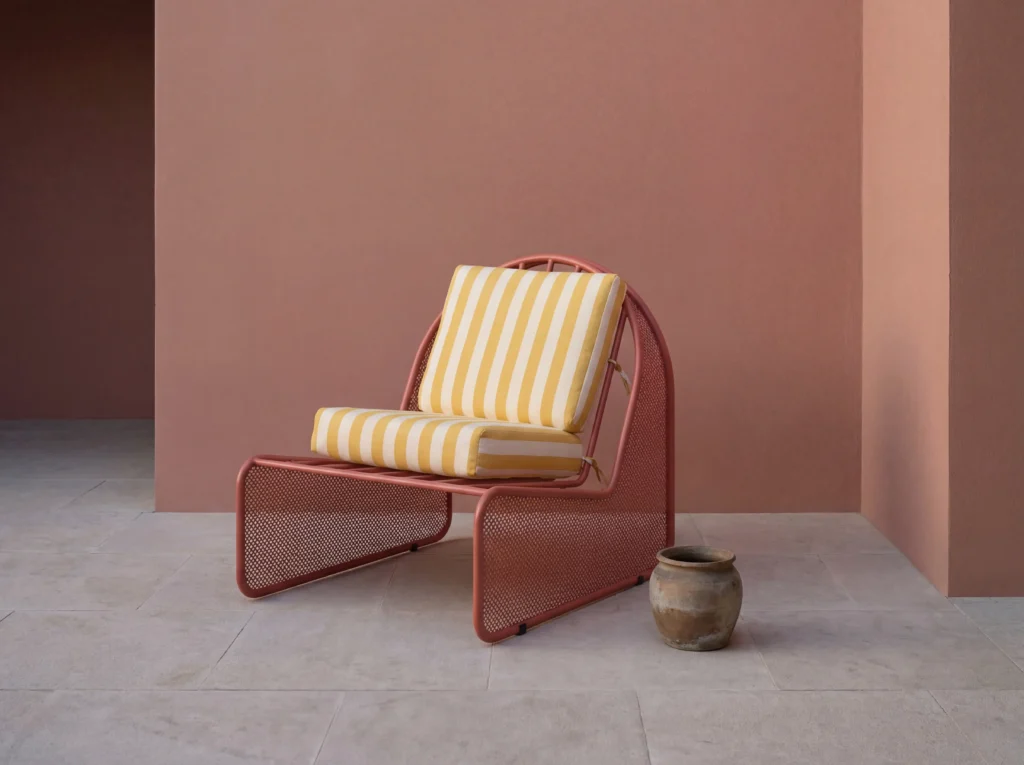
Logistics capacity matters for wholesale-scale orders.
Quality Control & Certifications
Certifications are not optional—they’re the baseline for doing business in professional markets. Here’s what to request and why each matters:
Essential certifications:
• BIFMA X5.4: Lounge seating durability. Tests structural integrity through 100,000+ cycles. Required for hospitality, education, and government contracts in North America.
• REACH/RoHS compliance: European chemical safety. REACH covers all chemicals in production; RoHS covers restricted hazardous substances. Without these, your products can’t legally sell in the EU.
• CAL TB 117-2013: Fire retardancy for upholstered outdoor furniture. Required for California and increasingly adopted nationwide. Affects foam, fabric, and filling materials.
• Salt spray test (ASTM B117): 72+ hours minimum for standard commercial use; 500+ hours for premium. Tests coating corrosion resistance. This single test predicts outdoor lifespan better than any other metric.
• EN 581 (Europe): Outdoor furniture safety and structural standards. Required for CE marking.
Third-party inspection process (budget $300-800 per inspection):
Stage 1 — Raw material check: Verify steel/aluminum grade with spectrometer. Check gauge with calipers. Inspect powder coating samples for color match.
Stage 2 — In-process (mid-production): Weld quality (no porosity, proper penetration), coating thickness (60-80 micron target), assembly fit-check for first 10 units.
Stage 3 — Pre-shipment (AQL 2.5 or 4.0): Random sample of 10-20% of finished goods. Check dimensions, functionality, finish, packaging integrity. Critical defects = reject entire lot.
Stage 4 — Container loading: Verify container condition (no holes, clean), check loading pattern (heavy items at bottom), confirm carton markings and labeling, take photos of each loading row.
Factory visit checklist:
• Is the production floor organized (5S methodology visible)?
• Are there separate QC inspectors, or do line workers check their own output?
• Is finished goods stored indoors (climate-controlled) or outdoors (rust risk)?
• How many welding stations use jigs/fixtures vs freehand? (jigs = consistent quality)
• Is there a dedicated coating lab with thickness gauges and salt spray chamber?
• Do they have ISO 9001:2015 certification (quality management system)?
Common Sourcing Pitfalls & How to Avoid Them
After a decade of working with B2B buyers, these are the most expensive mistakes we see repeatedly:
1. The ‘Rock-Bottom Price’ Trap
A buyer finds a factory quoting 30% below market average. They place a 500-unit order. When the container arrives, the powder coating peels after 3 months, 15% of the chairs have wobbly legs, and the steel gauge is 1.0mm instead of the specified 1.5mm. The buyer now faces: full container return shipping ($4,000), refund obligations to their customers, and a damaged brand reputation. The ‘$15,000 savings’ becomes a $50,000 loss. Rule: if a price seems too good to be true, the factory is cutting corners somewhere—usually in material quality or coating. Always compare pricing from 3-5 factories and be suspicious of outliers on either end.
2. Skipping the Sample Round
Buyers in a rush skip sample ordering and go straight to production. The factory uses a similar-looking but lower-grade steel. The color doesn’t match the Pantone code. The packaging is single-wall corrugated instead of double-wall, leading to 20% damage rates. A $200 sample order (including express shipping) would have caught all of these. Standard rule: minimum 3 sample rounds—first for look/feel, second for color/finish approval, third for production pilot (50 units minimum). Never commit to full production without approving a pilot batch.
3. Ignoring Packaging Quality
The cheapest quote often uses the cheapest packaging: single-wall cartons, thin polybags, no corner protection, minimal foam padding. Result: 10-20% damage rate in transit. Quality packaging (double-wall cartons, foam corners, proper palletizing, corner boards, straps) adds $1-3 per chair but reduces damage claims to under 1%. The math is simple: $2 extra packaging × 1,000 chairs = $2,000. One damaged container with 200 ruined chairs at $30/chair = $6,000 loss + return shipping + customer dissatisfaction. Negotiate packaging requirements and inspect the first 10 cartons before full production.
4. Unclear Specifications
The most common source of disputes is vague specifications. ‘Steel chair, black, good quality’ means very different things to different factories. A proper spec sheet includes: steel grade (e.g., Q195 cold-rolled, 1.5mm ±0.05mm), finish (epoxy e-coat + polyester powder coat, RAL 9005, gloss 30%), packaging (double-wall carton, foam corner protectors, 4 units per carton, palletized with stretch wrap), and tolerance (±1mm for dimensions, ±2° for angles). Every dimension that isn’t specified is an opportunity for the factory to cut costs.
How to Start Sourcing
1. Define specs: material, dimensions, weight, finish, packaging. Include target price and annual volume. Be specific—’carbon steel, 1.5mm wall thickness, electrostatic powder coating, RAL 9005 black, flat-pack with polybag and corner protection, target FOB $18-22/chair, annual volume 5,000 units’ will get you far more accurate pricing than ‘I need some outdoor chairs.’
2. Shortlist 10-15 manufacturers via Alibaba, Global Sources, or trade shows (Canton Fair, CIFF Guangzhou). Check export history—factories exporting to the US/EU annually understand compliance requirements. Alibaba’s ‘Assessed Supplier’ badge with factory audit report is your quick filter; skip suppliers who can’t provide clear factory photos or video.
3. Send detailed RFQ to 5-8 factories—specificity gets accurate pricing. Include technical drawings if possible. A good RFQ template includes: product specs, target quantity, target price, packaging requirements, labeling needs, inspection requirements, desired lead time, and target port. This weeds out factories that can’t meet your specs before you waste weeks in email negotiations.
4. Order samples from top 3 candidates—$200 in samples saves $20,000 in mistakes. Don’t skip this step even for urgent orders. Test assembly, check weld quality with a magnet (carbon steel vs stainless steel substitution is common), measure actual vs stated dimensions, and have a team member sit on the chair for 15 minutes to evaluate comfort and stability. Record everything with photos and videos.
5. Negotiate terms: 30% deposit, 70% before shipment. Ask about warranty (1-3 years standard for metal outdoor furniture). Clarify what the warranty covers—manufacturing defects only or also finish/powder coating peeling? Many factories exclude finish defects despite them being the most common issue. Also negotiate lead time penalties and rejection terms for non-conforming goods.
Build relationships, don’t just place orders. The buyers who get priority during peak season are those who treat manufacturers as partners—paying on time, communicating clearly, and visiting regularly. A factory visit is invaluable: see the production line, meet the QC team, inspect finished goods, and assess working conditions before committing to large volumes. Schedule visits during production, not just during scheduled tours.
Ready to Find Your Partner?
At Colors Furniture, we’ve been manufacturing and exporting carbon steel outdoor furniture for over a decade. Our 50,000 sqm factory in Foshan produces 1,500+ containers annually for clients across North America, Europe, and Australia.
Contact us to discuss your next project, request samples, or schedule a factory visit.